history of pearls
The History of Pearls
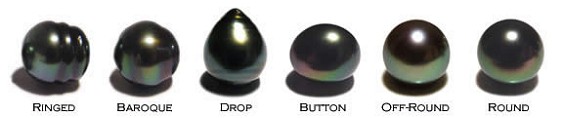
The history of pearls has always been linked to the history of mankind. Pearls have fascinated humans since more than 5000 years. The existence of pearls was documented 2200 B.C. for the first time. Enchantment and immaculate shape made them a cherished symbol of elegance for ancient and modern cultures. Roman emperors used pearls and fine garments to create matchless gems. Mother of pearl was one of the first and finest materials artists discovered for the creation of ornaments and jewellery. The oldest formations of cultured pearls known to mankind were located in the Arab Gulf region, along the shores of Persia, Saudi-Arabia, Kuwait and the Red Sea. The most ancient pearl from the Persian Gulf dates back 4000 years. During the glorious times of the Romans, the emperors discovered a passionate love for pearls. Their desire for the precious gem was insatiable. This love reflects in the Latin language as well. The word ‘Margarita’ means pearl - and mistress. Elisabeth I, Queen of England, topped everyone’s adoration for pearls. She used to wear heavy strands of pearls constantly. She was the vain owner of splendiferous gowns embroidered with a treasure of 3000 pearls. The symbols of purity and perfection represented affluence and power since a very long time. In clerical art, pearls were regarded as precious symbols for the love of god, adorning altars and a variety of clerical objects as well as priestly robes. Pearls, immaculate in their natural condition, do not need any further treatment, like other gems, to shine in unequalled beauty. Types of Pearls1. cultured pearls:Freshwater cultured pearls offer an enormous variety of shapes and sizes, which is why they are popular all over the world. The size of the freshwater cultured pearls varies from 2 - 8mm, the average measures approximately 4 - 5mm. Rarely freshwater cultured pearls with a size of more than 10mm are found. Cultivation of those charming pearls dates back until the 13th century. The famous Japanese 'Biwa' pearls used to control the industry from 1924 until well into the 70's. The Biwa Lake in Japan, like so many others, became a victim of environmental pollution caused by adjoining factories and urban sprawl. The extensive freshwater pearl production in the waters of Lake Biwa came to an end. 2. Akoya pearlsSince oysters are relatively small, the average size of Akoya pearls (Saltwater Pearls) varies from 2 to 9 mm. Originally cultured in Japan, the so-called Akoya pearls were the most popular saltwater pearls for almost a century. Until the 90’s the production was controlled by Japanese companies. As from 1990, China started cultivating Akoya pearls in remarkable quantities which meant serious competition for Japan’s production fairly soon. Pinctada fucata martensii, is the nomenclature for the double-shelled mussel of the species Pteriidae, used to cultivate Akoya pearls. Just like freshwater pearl production, the saltwater pearl cultivation starts by implanting a perfectly rounded mother-of-pearl nucleus along with an irritant into the oyster. Only two, maximum four nucleuses can be hosted at the same time, while freshwater pearl cultivation allows implantation of several more. Tahitian pearl cultivation allows one nucleus per mussel only. After the harvest, Akoya pearl producing mussels will not be nucleated again. Untreated Akoya pearls are mainly cream coloured, yellow or green. The pearls displayed in shop-windows are the result of a sophisticated treatment applied to eliminate impurities. Shapes vary from ovate, button-shaped, drop-shaped to baroque. The Value of Akoya pearls depends on their size, shape, colour and luster, as well as on the composition of their surface. For necklace of exceptional quality made of pearls measuring 8-9 mm, one has to part with a couple of thousand dollars. 3. Tahitian pearls:The major feature of black Tahitian pearls is their large size. Black Tahitian pearls belong to the group of South Sea pearls and can measure between 9 and 17 mm. A thick and healthy mother-of-pearl layer around the implanted nucleus creates an immaculately natural colour, luster and beauty. These black pearls do not require any artificial improvement, which is why they are admired as the "Queen of pearls". Pearl GradingThe following criteria is important to assess the quality of a pearl: 1. size:The size of a pearl is the only feature visible for every viewer. it is measured in millimetres. There are pearls measuring a few millimetres only while South Sea pearls can reach a size of 20 millimetres diameter. Generally speaking, a larger pearl is more precious than a smaller one, while all other criteria have to be similar. 2. shape:The shape of cultured pearls is generally divided into round, symmetric and baroque. Round shapes: almost and perfectly round To find a perfectly round pearl is extremely difficult. The closer the pearl’s shape is to a perfect round, the more valuable it is. In the end, preferences depend on the individual taste.
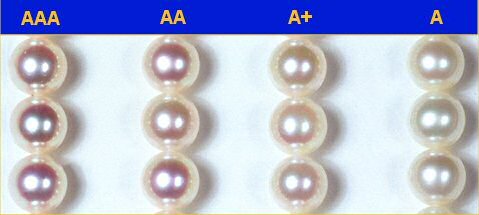
3. colour:To judge the colour of pearls, a basic tone, luminosity and colour depth is considered. Akoya pearls show a spectrum covering shades of white, cream or soft pink. South Sea pearls shimmer in white, silver, pink or gold. Tahitian pearls are famous for their dark shades. A light grey is found, as well as gold, black-green to black.
4. luster:The Iridescence of pearls is called ‚luster’ or ‘Orient’. Pearls show this glamorous play of colours in delicate nuances due to the bow in their surface, enabling us to perceive their brilliance from every angle. The interaction of light rays and surface creates the iridescence, the so called ‘surface colour’ visible as a small circle on the pearl’s outer layer of nacre. The luster depends on the thickness of nacre, numerous layers encasing the nucleus. The layers of nacre act like tiny prisms, refracting light, so it appears as all the colours of a rainbow.
| |||||||||||||||||